What matters
- Professional skincare retail accounts for 20 to 30 percent of total revenue at high-performing med spas, according to Skytale Group, while most practices fall well short of that range.
- The Global Medical Spa Market was valued at USD 21.67 billion in 2024 and is projected to reach USD 64.46 billion by 2032 at a 14.60% CAGR, meaning the competitive gap between practices that capture retail revenue and those that do not will widen fast.
- Patient education at the point of care, specifically provider-led recommendations tied to treatment outcomes, is the primary driver of retail conversion at practices that hit the 20-30% benchmark.
Most med spas are treating retail as an afterthought, a shelf of products near the front desk that patients walk past on their way out. According to Skytale Group, professional skincare accounts for roughly 20 to 30 percent of total revenue at high-performing practices, while the majority of med spas fall well short of that range. That gap is not a supply problem. It is a missed conversation problem.
What Does the 20-30% Retail Benchmark Actually Mean for a Med Spa?
If your practice generates $800,000 in annual revenue, the 20 percent threshold represents $160,000 from retail skincare sales alone. At 30 percent, that number climbs to $240,000. According to Skytale Group, patients are actively increasing their investment in skin health, and practices that meet them there with the right products and guidance are capturing a disproportionate share of that spending.
The backdrop matters here. According to Data Bridge Market Research, the global medical spa market was valued at USD 21.67 billion in 2024 and is expected to reach USD 64.46 billion by 2032, growing at a compound annual growth rate of 14.60 percent. That rate of expansion means new competition enters the market constantly. A practice that has not built retail into its revenue model today will find it harder to add later when margins are under more pressure and patients have more choices.
Why Do Most Practices Miss That Number?
The most common failure is structural, not motivational. Retail gets assigned to front desk staff who were hired to check people in and out, not to discuss active ingredients or explain why a post-treatment serum matters. Providers complete a service and hand the patient off without a product conversation attached to the clinical outcome they just delivered.
According to Spakinect, 84 percent of med spa owners are projecting revenue increases, which suggests most operators are optimistic about growth. But projecting revenue growth and building the systems to generate it from every available channel are different things. A practice that relies entirely on treatment bookings to hit those projections is leaving a verified revenue stream uncollected.
There is also a product confidence gap. When providers are not consistently trained on the retail line, recommendations become inconsistent or stop happening entirely. Patients pick up on that. If the person who just performed your IPL treatment does not mention a specific product when explaining aftercare, the message sent is that no product is particularly necessary.
How Does Patient Education Translate Into Retail Revenue?
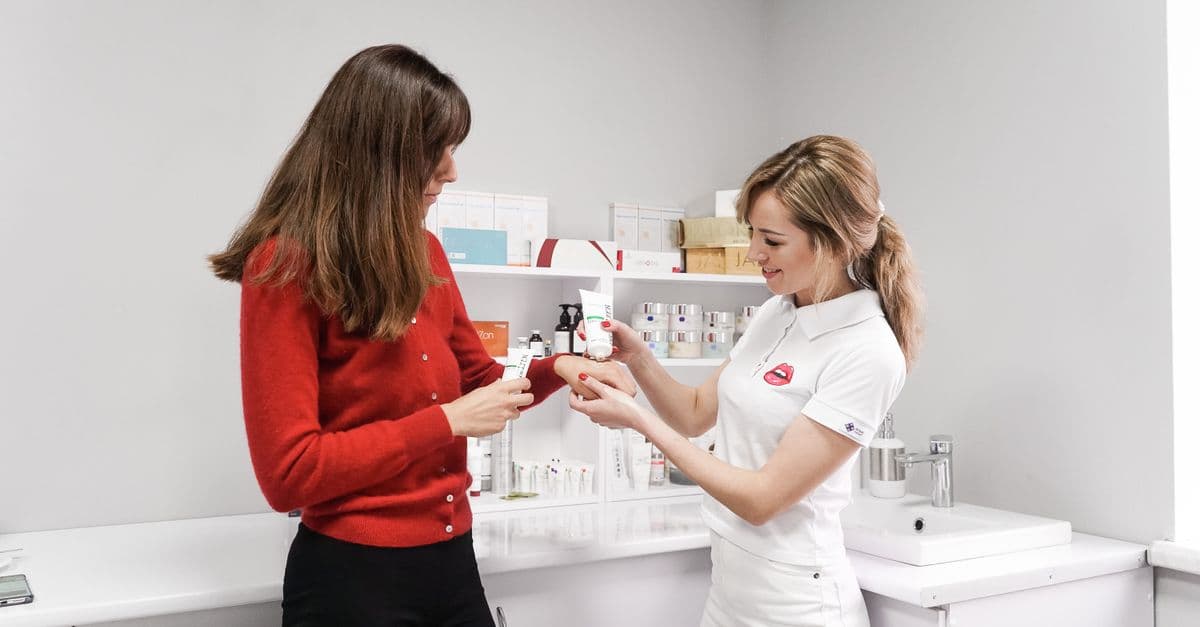
According to Skytale Group, the practices hitting the upper end of the retail revenue benchmark are doing it through provider-led education tied directly to treatment plans, not through passive product displays or front-desk upsells. The conversation happens in the treatment room, connected to the specific outcome the patient came in for.
That framing matters because it changes how the patient receives the recommendation. A provider explaining that a vitamin C serum will protect the investment made during a laser resurfacing treatment is giving clinical context. That is different from a front desk associate mentioning a product while processing payment. One feels like advice. The other feels like a sale.
The mechanics are straightforward: providers need to know the product line, have a short script connecting each product to a treatment outcome, and make the recommendation before the patient leaves the treatment room. Checkout becomes confirmation, not introduction. For practices that have coverage in related areas like shifting client expectations or are working on converting reputation signals into bookings, retail is one more place where the patient experience either reinforces trust or creates friction.
Why This Matters for Med Spas
The retail revenue gap is not a niche problem for practices that happen to carry skincare products. It is an operational gap that compounds over time. Every patient who leaves without a product recommendation is a patient who may buy the same product from an online retailer, from a competitor, or not at all. The practice gets none of that revenue and loses some of the clinical outcome it could have reinforced.
At a 14.60 percent annual market growth rate, according to Data Bridge Market Research, new med spas will continue to open in most markets. Many of them will enter with retail programs already built in. Established practices that treat retail as optional are ceding ground that will be harder to reclaim once a newer competitor owns that part of the patient relationship.
The operational fix is not expensive. It requires training, scripting, and a consistent hand-off between provider and patient before the appointment ends. The practices already at 20 to 30 percent are not doing anything exotic. They have just built the conversation into the appointment itself.
If your practice is not tracking retail as a percentage of total revenue, start there. Once you know the number, you know the gap, and the gap tells you exactly where to focus the training conversation.